
In June 2026, lab member Xinke Jian attended IEEE ICC 2026 and presented A Copula-based Semantics-Structure Minimization Framework for QoS Guaranteed Wireless Communications, coauthored with Zhiyuan Ren and Wenchi Cheng. IEEE ICC is a flagship conference of the IEEE Communications Society. The work addresses a foundational question: when only minimal structural semantics are transmitted, as may be required in emergency communications, how can service quality be quantified and guaranteed?
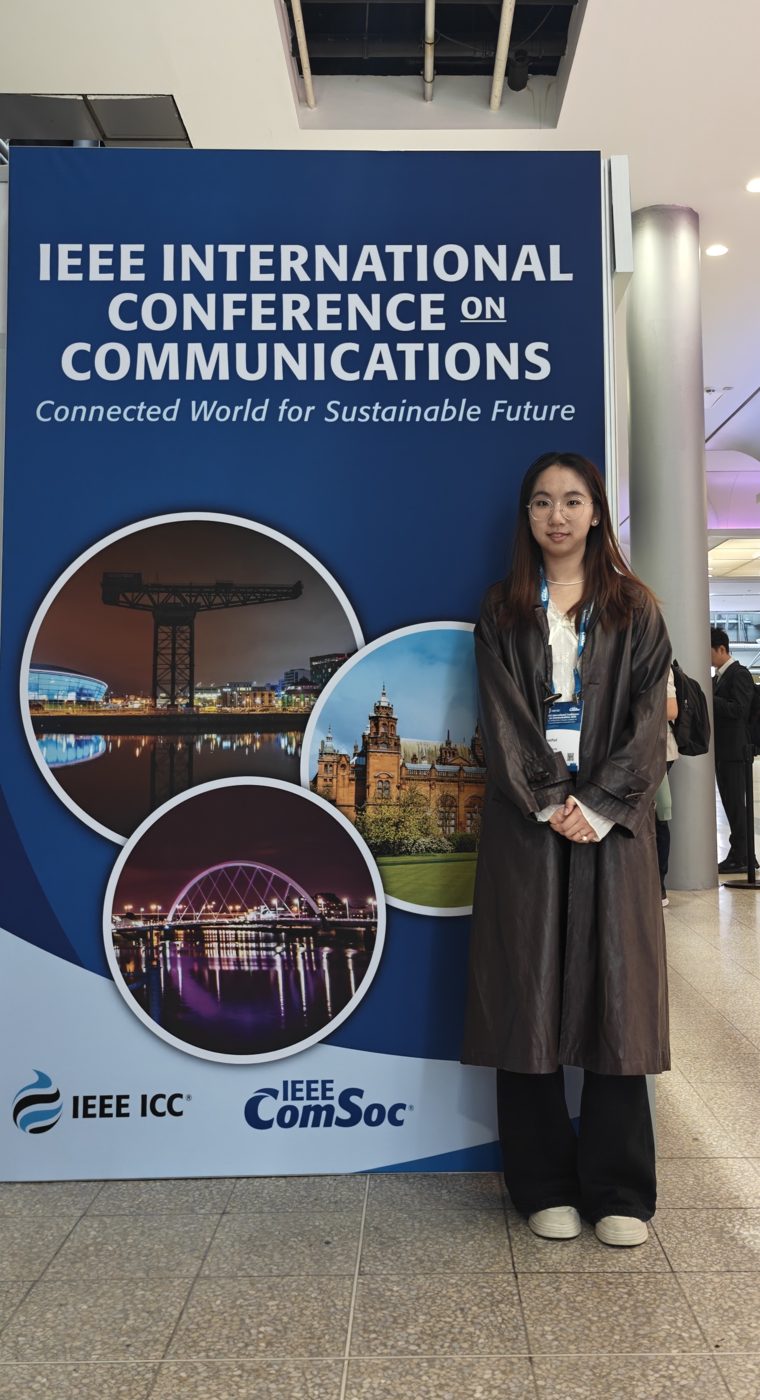 Xinke Jian at IEEE ICC 2026.
The problem: a theoretical foundation for semantic communications
Images, video, and XR dominate network traffic. As exact bitwise reproduction approaches its efficiency limits, semantic communications offers another approach. Much of the field relies on end-to-end trained neural networks, leaving three linked challenges: defining semantics mathematically, measuring semantic fidelity beyond perceptual similarity, and establishing performance limits that support meaningful semantic QoS commitments.
The approach: derive structural semantics from first principles
The framework locates minimal structural semantics in the dependence structure between pixels. This structure is invariant under monotonic transformations such as brightness or gamma adjustments.
- Four axioms: monotonic invariance, pairwise stationarity, minimal sufficiency, and a decomposable and stable distance. Under these axioms, the paper proves that the family of pairwise rank copulas {C_δ} is a minimally sufficient representation of minimal structural semantics.
- Semantic distortion Dpc: a distortion measure built on Jensen–Shannon divergence.
- Four theoretical results: sample-complexity and rate–distortion bounds, an end-to-end SLA achievability theorem, and a semantic source–channel separation theorem.
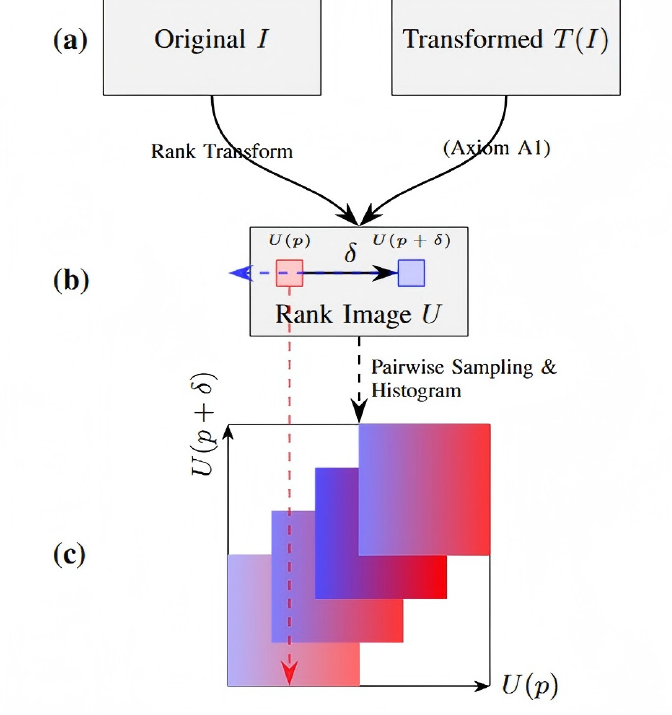 Figure 1. An image and its monotonically transformed version produce the same rank image. Pairwise sampling at displacement δ and histogram estimation then yield empirical copulas. Source: the paper.
Experimental findings
- Axiom validation: under a brightness increase of +80, Dpc is 0.00000, while LPIPS is 0.0686. The result illustrates the monotonic invariance required by the framework.
- Association with AI task performance: across 15 degradation levels spanning JPEG compression, blur, and noise, Dpc has a Spearman rank correlation of −0.896 with YOLOv8n detection mAP. The corresponding correlations are −0.961 for LPIPS, 0.782 for SSIM, and 0.750 for PSNR. The paper presents Dpc as a measure combining practical task relevance with its axiomatic guarantees.
- Rate–distortion evaluation: uniform scalar quantization of empirical copulas demonstrates compressibility and supplies a rate–distortion function for exploring the rate–computation–reliability trade-off in the SLA model.
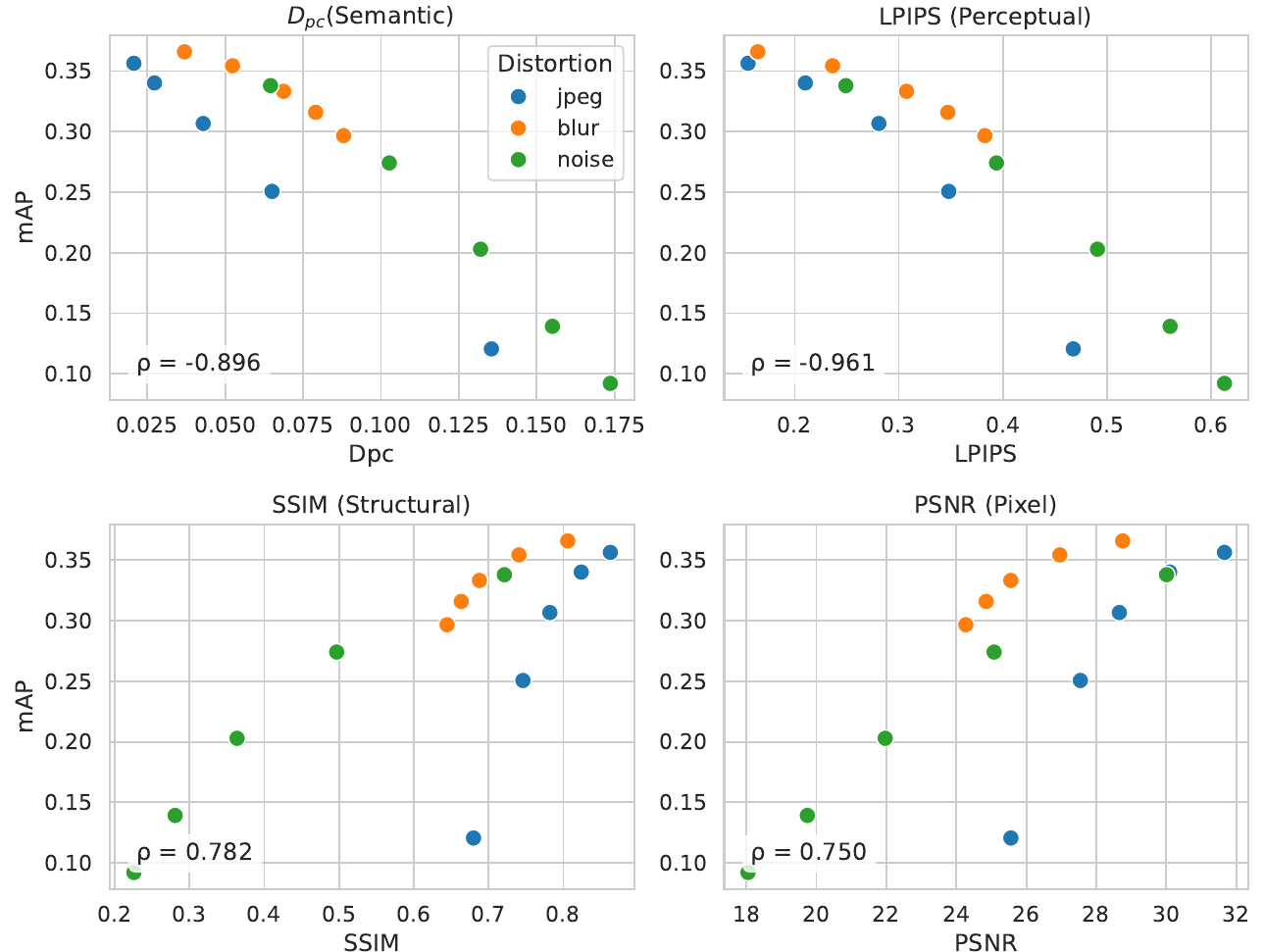 Figure 2. Correlations between task performance (mAP) and Dpc, LPIPS, SSIM, and PSNR across 15 degradation levels. Source: the paper.
Implications for Network as a Computer
The framework connects an axiomatic definition, a distortion measure, and performance bounds for engineering semantic QoS. Its scope is structural semantics: attributes such as color require separate transmission, and end-to-end guarantees depend on an adequately capable generative decoder. For CompIN Lab’s Network as a Computer vision, Dpc and the SLA achievability theorem provide a theoretical basis for deciding how much semantic data a network node can compress while meeting a task’s service requirements.
Publication
X. Jian, Z. Ren, and W. Cheng, “A copula-based semantics-structure minimization framework for QoS guaranteed wireless communications,” in Proc. IEEE Int. Conf. Commun. (ICC), 2026, doi: 10.1109/ICC59461.2026.11588192.