
Zhiyuan Ren, Tao Zhang, and Wenchi Cheng’s paper Packet-Level In-Network Semantic Adaptation for Unstable Mobile Emergency Networks has been published in Electronics, with Zhiyuan Ren as corresponding author. The paper addresses emergency networks in which links can change faster than feedback reaches the source. Its packet-level adaptation method, DINA, enables a relay to transform packets locally when its outgoing link deteriorates, reserving scarce bandwidth for task-relevant information.
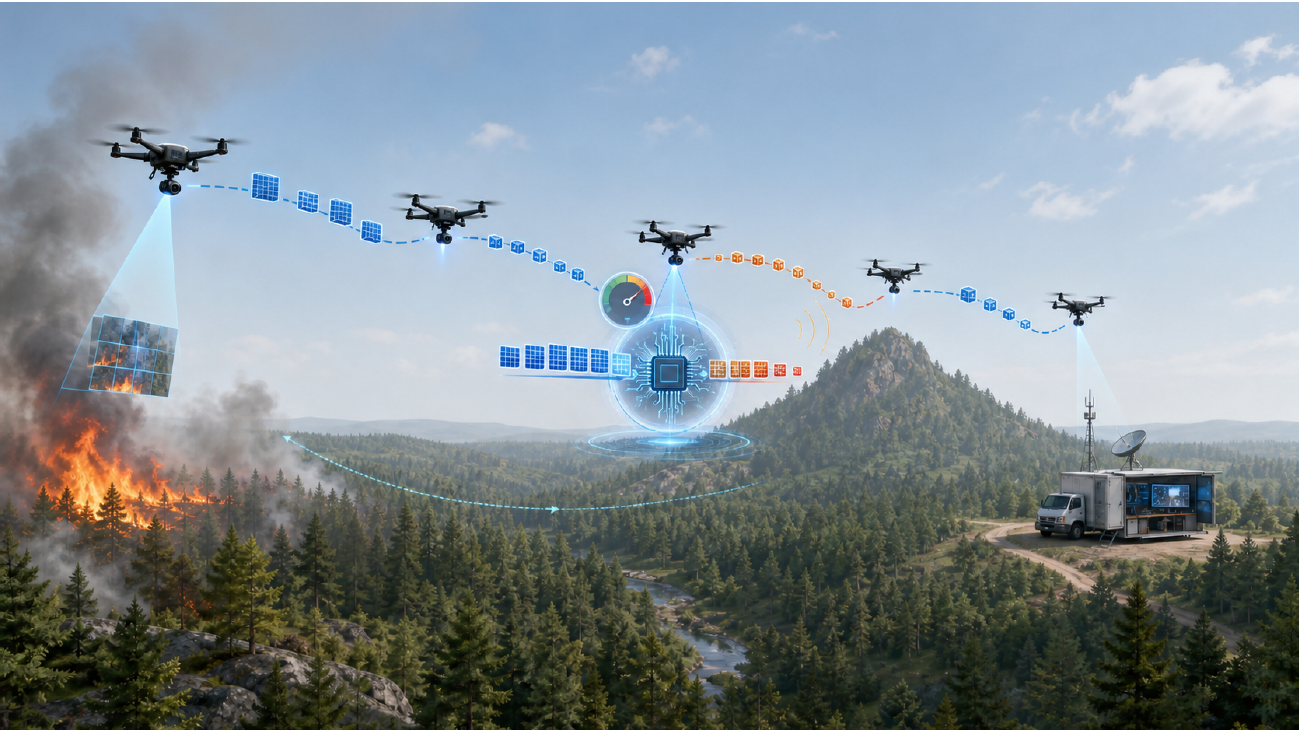 Figure 1. Sensing UAVs send large spatial image-tile packets (blue) through temporary relays. A relay facing a deteriorating outgoing link transforms compatible packets into smaller task-relevant representations (orange/red) before forwarding them. Source: the paper.
The challenge: feedback lags behind link changes
When infrastructure is unavailable or damaged, UAVs, vehicles, and robots act as sensors and relays. Mobility, obstruction, and contention cause multi-hop links to fluctuate, often at different rates along the same path.
End-to-end feedback lets a source adjust its encoding after learning about network conditions. At an intermediate bottleneck, however, this observation–feedback–action loop may arrive too late. A source-side change affects future packets; packets already queued at the relay need a local decision.
The approach: self-describing packets and local decisions
- Self-describing spatial packets: an image is divided into tiles. Each packet carries coordinates, its current representation type, and its payload so that a node can interpret and process it independently.
- Per-packet, local, stateless adaptation: at a capable node, a lightweight selector trained offline and frozen online scores compatible transformations using conditions at that node’s exact egress. The node transforms and forwards the packet without reconstructing the full image or maintaining cross-packet adaptation state.
- Progressive multi-hop adaptation: downstream nodes retain or further compress representations using the same typed compatibility rules.
- A simple receiver: received tiles are placed by coordinate, missing regions are filled with black, and a fixed machine task such as classification or segmentation is applied.
Evaluation in a 24-node UAV environment
The team implemented DINA using the Linux programmable data-plane technologies XDP and AF_XDP in a configurable 24-node UAV environment. The evaluation recorded 41,452 decisions, including 17,452 packets processed at multiple nodes. No incompatible representation transitions were observed, and relays operated without reconstructing images. The paper reports:
- Forest-fire classification under fluctuating links: compared with direct forwarding, image-tile coverage before the deadline increases from 40.4% to 72.6%, while classification accuracy rises from 77.5% to 95.0%. Delivered payload decreases from 7.45 MB to 0.79 MB; fire recall rises from 80% to 100%, and the false-positive rate falls from 25% to 10%.
- RescueNet disaster-scene segmentation, trained independently: coverage increases from 65.6% to 91.7%, and foreground mIoU rises from 0.486 to 0.541.
- Operating limits: DINA offers little additional benefit when capacity is ample. Under extremely scarce capacity, both methods can experience task failure.
Implications for task-aware in-network computing
DINA is a concrete step toward the lab’s Network as a Computer vision. Network nodes execute task-relevant computation in the data path, placing adaptation at the hop where changing conditions are observed. This design can support forest-fire monitoring, disaster search and rescue, and emergency command, while offering a model for in-network computing and task offloading in programmable networks.
Publication
Z. Ren, T. Zhang, and W. Cheng, “Packet-level in-network semantic adaptation for unstable mobile emergency networks,” Electronics, 2026, doi: 10.3390/electronics15204641.