
Zhiyuan Ren, Xinke Jian, Wenchi Cheng, and Kun Yang’s paper The Landscape of Fairness: An Axiomatic and Predictive Framework for Network QoE Sensitivity has been accepted for publication in IEEE Transactions on Network and Service Management (TNSM). The work turns fairness assessment from a measurement at a single operating point into a predictive engineering framework. Operators can examine how changes to service-level agreement (SLA) parameters influence fairness and how sharply that influence varies.
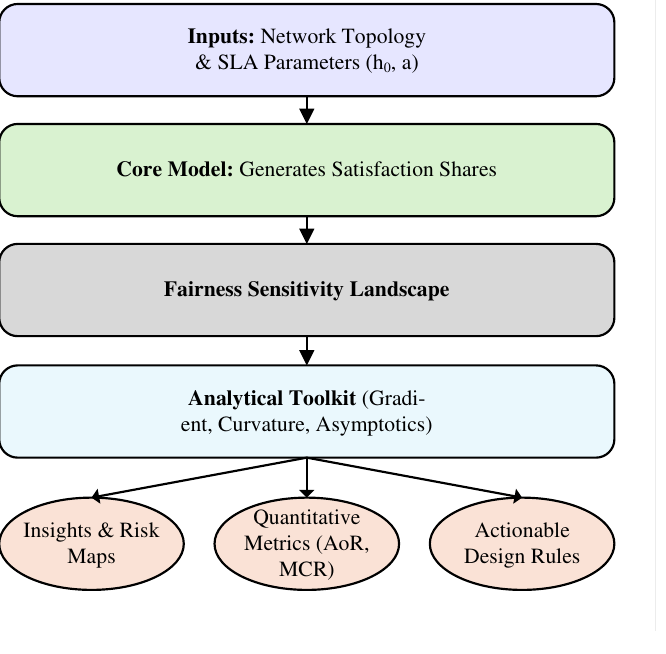 Figure 1. Network topology and SLA parameters produce satisfaction distributions and fairness-sensitivity landscapes. Gradient, curvature, and asymptotic analyses then yield risk maps, metrics including AoR and MCR, and actionable design rules. Source: the paper.
The problem: fairness can be highly sensitive to SLA settings
Networks carry diverse services whose requirements become control objectives through SLAs. Shared links, switches, and backbone capacity create competition. Small changes to SLA thresholds can be amplified by routing, scheduling, and resource allocation, favoring flows with more advantageous paths. The paper studies how fairness itself changes across SLA parameter settings.
The approach: an axiomatic measure, a local compass, and a global map
- An axiomatic QoE-imbalance measure: the paper derives the measure uniquely from a set of fairness axioms.
- A covariance law: a closed-form expression relates the imbalance gradient to the covariance between a path’s information-theoretic importance and its parameter sensitivity. This provides a local indication of whether tightening an SLA improves or worsens fairness.
- Phase diagrams and curvature: fairness surfaces across the SLA parameter space reveal robust stable belts and high-risk dangerous wedges. Curvature analysis yields topology-aware design guidance, including a threshold-first tuning strategy.
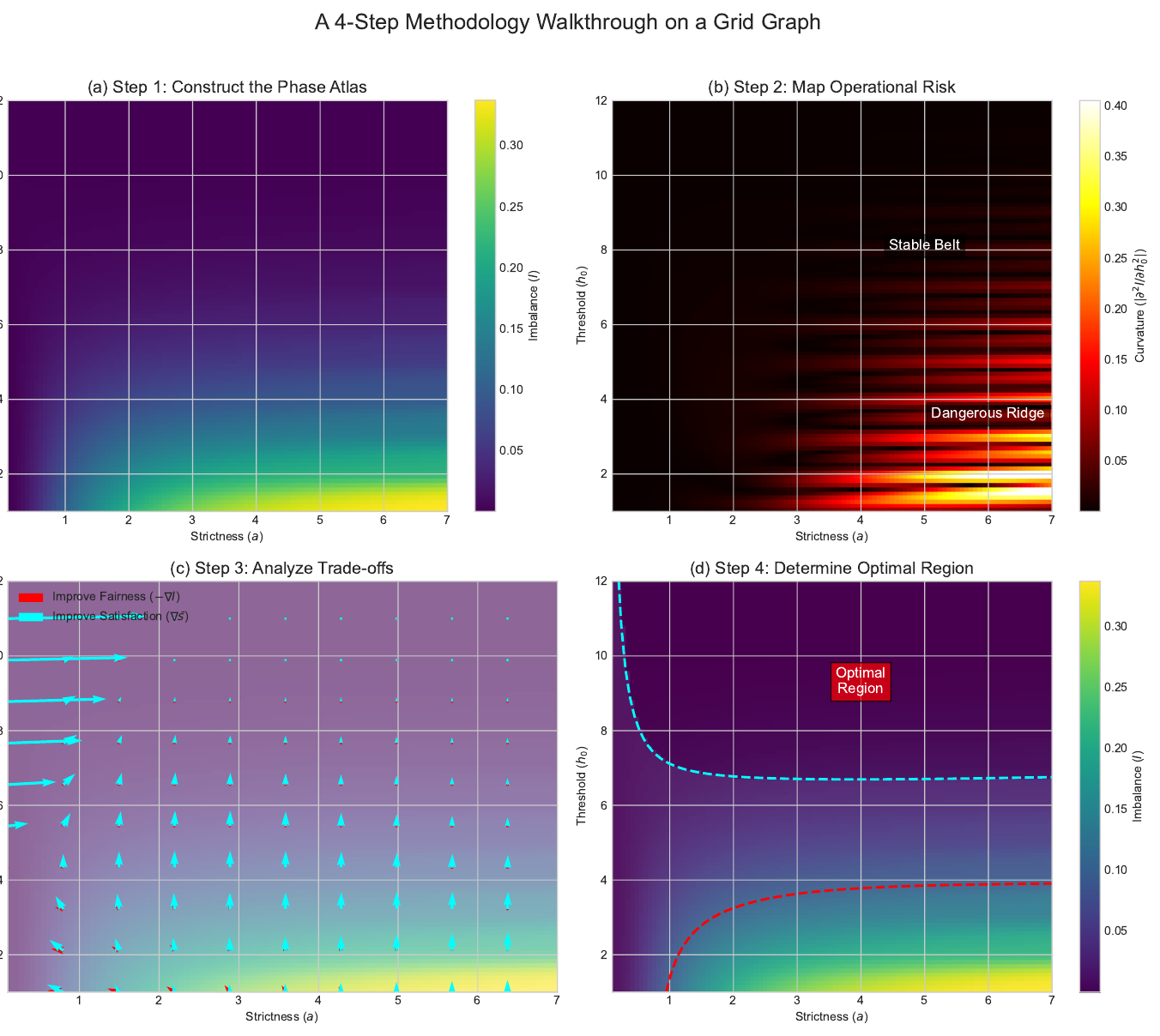 Figure 2. A four-step analysis on a 7 × 7 grid: construct the imbalance phase diagram, map operating risk, examine trade-offs, and identify a preferred operating region. Source: the paper.
Quantitative findings
- The threshold direction is much steeper: on the 7 × 7 grid, curvature along threshold h₀ at high-risk ridges is 10²–10³ times that along strictness a, motivating the threshold-first rule.
- Topology shapes stable belts: in the Barabási–Albert topology example, more than 90% of paths have two or three hops. This concentration in path length produces a broad stable region for h₀ > 3.
- Robustness on an AS backbone: in the 10-core subgraph, the baseline area of robustness (AoR) is 84.60%. Removing the highest-degree 1% of nodes reduces it to 69.22% and broadens and strengthens high-risk ridges. Removing high-betweenness links has a smaller effect in the reported evaluation, highlighting the importance of hub nodes for fairness robustness in that topology.
Implications for predictable network management
The framework lets operators map fairness risk before configuring an SLA, identify vulnerable hubs during topology design, and prioritize careful threshold adjustment. For the lab’s Network as a Computer vision, interpretable and predictive QoS analysis contributes to precise scheduling and management, including SLA orchestration in programmable networks and allocation of edge computing resources.
Publication
Z. Ren, X. Jian, W. Cheng, and K. Yang, “The landscape of fairness: An axiomatic and predictive framework for network QoE sensitivity,” IEEE Trans. Netw. Serv. Manag., 2026, doi: 10.1109/TNSM.2026.3702766.